

The Renters’ Rights Act Information Sheet: What Landlords Need to Know
Published on March 31, 2026 by Sarah Mac

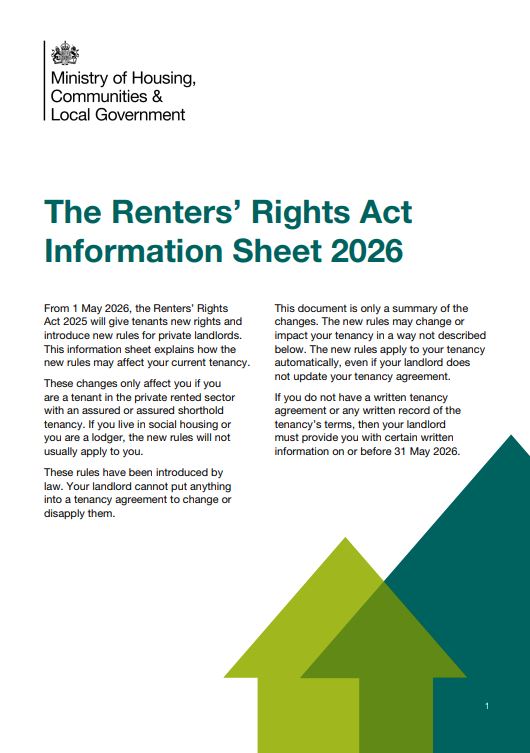
The government has now published the official Renters’ Rights Act Information Sheet 2026, introducing a new legal requirement that landlords cannot overlook.
Designed to help tenants understand the changes brought in by the Renters’ Rights Act 2025, the Information Sheet must be provided to certain tenants within a strict timeframe.
In this guide, we explain what the Information Sheet is, who needs to provide it, how to serve it correctly, and what happens if you don’t.
What is the Renters’ Rights Act Information Sheet?
The Renters’ Rights Act Information Sheet is an official document published by the UK Government. It sets out the key changes introduced under the Renters’ Rights Act and explains how these affect tenants’ rights and responsibilities.
Its purpose is simple: to ensure tenants are properly informed about the new rules, particularly where tenancies were created before the legislation comes into force.
For landlords, this is not just guidance — it is a formal requirement that must be followed where applicable.
Why this matters for landlords
This is a legal obligation, not an optional update or best practice.
The introduction of the Information Sheet forms part of a wider shift towards greater transparency and standardisation across the rental sector under the Renters’ Rights Act 2025. It ensures tenants receive consistent, government-approved information about their rights.
For landlords, this means:
- An additional compliance step
- A fixed deadline
- Clear expectations around how the information must be delivered
Failing to meet these requirements can lead to enforcement action, so it is important to act early and get it right.
Who needs to provide it — and when?
The requirement applies where all of the following conditions are met:
- The tenancy is an assured or assured shorthold tenancy
- It was created before 1 May 2026
- There is a wholly or partly written agreement in place
Landlords must provide the Information Sheet to every named tenant.
Deadline:
The document must be served by 31 May 2026.
Exclusions:
Lodgers are not included
Fully verbal tenancies cannot use the Information Sheet and instead require written information outlining key terms
If a letting agent manages the property, they also have a responsibility to ensure the document is served.
How to serve the Information Sheet correctly
This is where many landlords are likely to trip up.
The Information Sheet must be provided exactly as issued by the government. It cannot be edited or adapted.
You must:
- Download the official PDF version
- Provide it to each tenant individually
It can be served in one of two ways:
- As a printed copy, delivered by hand or post
- As a digital attachment (for example, via email or text message)
Important:
Sending a link to the document is not sufficient and will not meet the legal requirement.
Taking a moment to check this has been done correctly could avoid significant issues later.
What happens if you don’t comply?
Failure to provide the Information Sheet is a breach of your legal obligations.
Tenants can report non-compliance to their local authority, and this may result in financial penalties.
Current guidance indicates:
- Fines of up to £7,000 for a single breach
- Up to £40,000 for ongoing non-compliance
Beyond the financial impact, failing to follow the correct process could also weaken your position if disputes arise later.
Key changes tenants will see
The Information Sheet highlights several important changes under the Renters’ Rights Act, including:
- All tenancies becoming periodic (rolling)
- The removal of Section 21 “no-fault” evictions
- Rent increases limited to once per year via Section 13 notice
- Expanded tenant rights, including around pets and property standards
- Stronger requirements for written tenancy terms
For landlords, these changes represent a shift in how tenancies are managed and how disputes may be handled.
Practical next steps for landlords
With the deadline approaching, it is worth taking a structured approach:
- Download the official Information Sheet from the government website
- Identify all affected tenancies created before 1 May 2026
- Provide the document to every named tenant
- Keep a clear record of how and when it was served
- If using a letting agent, confirm they have also complied
- Allow tenants time to review and understand the changes
Acting early reduces the risk of missed tenants, errors in service, or last-minute pressure.
Why accurate property records matter more than ever
With increased scrutiny on tenant rights and landlord obligations, clear documentation is becoming even more important.
Inventory, check-in and check-out reports provide a reliable record of a property’s condition at key points in a tenancy. These reports often form part of the evidence considered if disputes arise.
While the Information Sheet focuses on tenant awareness, accurate reporting remains essential in supporting clarity, consistency and fair outcomes for all parties.
Final thoughts
The Renters’ Rights Act Information Sheet is a relatively simple requirement — but one that must be handled correctly.
Making sure it is served properly, to the right tenants, and within the required timeframe will help you stay compliant and avoid unnecessary penalties. As with many regulatory changes, the detail matters. Taking a little time now to get everything in order will save far more time — and potential cost — later on.